Assessment & Intervention

Understanding every pupil, planning the right support and helping them make progress

At River Tees Hospital School, assessment and intervention are central to understanding each pupil as an individual. We take the time to understand their strengths, needs, experiences and aspirations so that we can provide the right support at the right time.

Our approach is child-centred, collaborative and evidence-informed, working closely with pupils, families, home schools, healthcare professionals and other agencies.

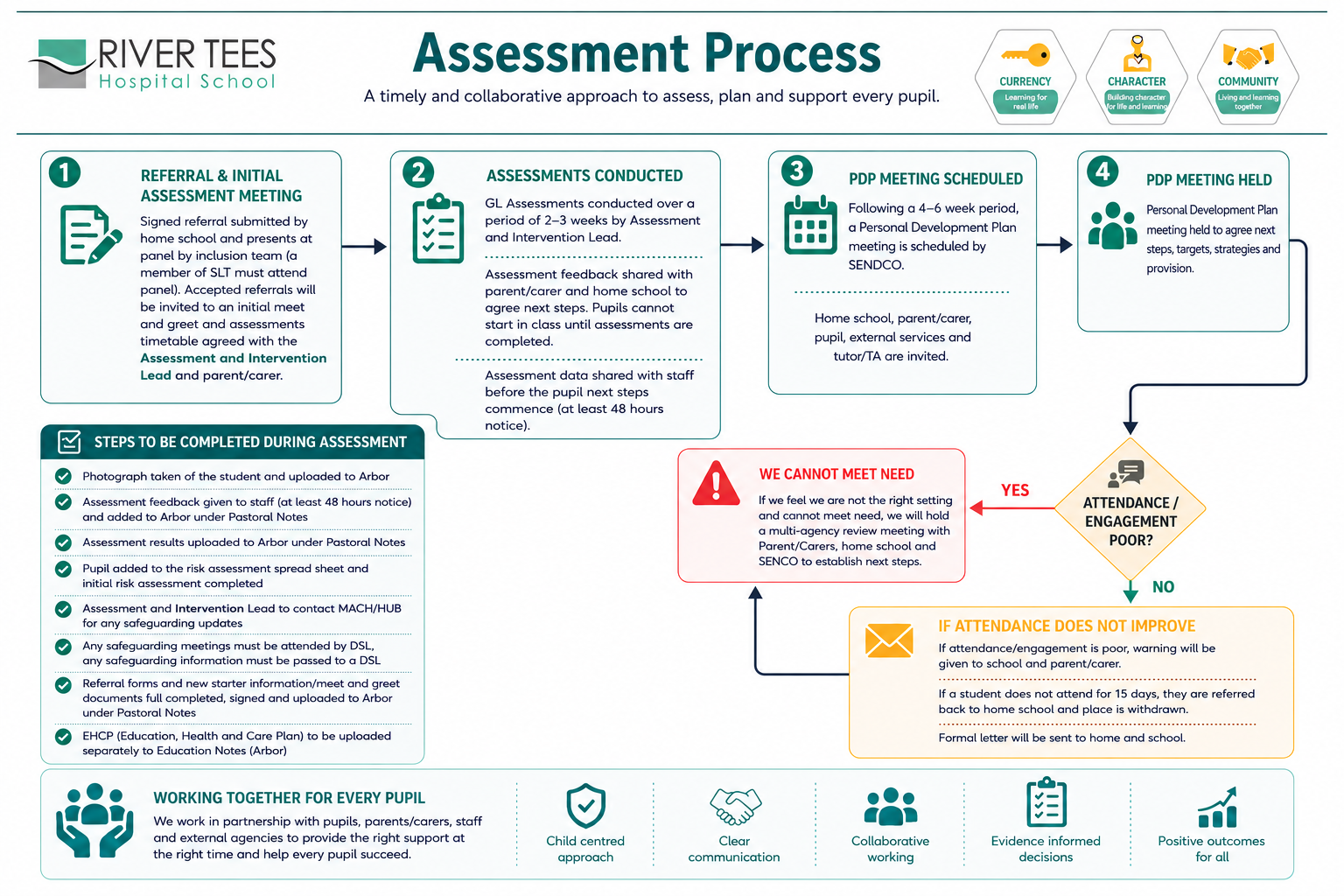
When a pupil offered a place at Hospital School, a member of our team often our Assessment and Intervention Lead meets with the pupil and their family.

This first meeting is friendly, informal and focused on building relationships. We recognise that arriving at Hospital School can feel very different from starting at a mainstream setting, so our priority is to help pupils feel safe, understood and welcomed.

Our initial meeting helps us to:

  • Understand the pupil’s emotional and physical readiness for learning.
  • Gather important background information about their education, interests and individual circumstances.
  • Begin to understand their strengths, needs and aspirations.
  • Reassure pupils and families that education will continue in a supportive, flexible and personalised way.
  • Begin building the trusting relationships that underpin successful learning.

“We see first-hand that learning can only begin when a child’s mental and emotional wellbeing is prioritised.”

Once a pupil feels comfortable and ready, we begin a more comprehensive assessment process.

Our assessments are designed to give us a rounded understanding of the whole child, helping us identify strengths, barriers to learning and areas where additional support may be beneficial.

Where appropriate, assessment is informed by information from healthcare professionals, the pupil’s home school, parents/carers and other professionals involved in their care.

The information gathered helps us to develop a personalised education pathway and identify appropriate teaching, pastoral and therapeutic support.

Academic Assessment

We use a range of recognised assessments to establish each pupil’s current levels of attainment and identify specific areas for development, including:

  • Reading, comprehension and spelling age
  • Dyslexia and Dyscalculia screening
  • DASH – Detailed Assessment of Speed of Handwriting
  • English – GCSE Indicator
  • Mathematics – GCSE Indicator
  • Science – GCSE Indicator

This information enables our teachers to identify gaps, recognise existing strengths and ensure learning is pitched appropriately.

Personal Development and Wellbeing

Academic progress is only one part of a pupil’s journey. We also consider their wider personal development, wellbeing and readiness to engage with learning.

Our assessment approach includes:

Thrive Baseline Skills Assessment

This helps us develop an understanding of a pupil’s current social and emotional development and identify areas where targeted support may help them to feel more confident, connected and ready to learn.

My Family Tree

This provides an opportunity to understand the people, relationships and experiences that are important to each pupil, helping staff to develop a more personalised understanding of their background and support network.

EPOCH Wellbeing Measure

The EPOCH measure helps us explore five positive characteristics associated with wellbeing:

  • Engagement
  • Perseverance
  • Optimism
  • Connectedness
  • Happiness

The assessment helps us recognise individual strengths while identifying areas where additional support may be beneficial. It contributes to our understanding of pupils’ positive psychological functioning and helps inform personalised approaches to wellbeing and personal development.


Assessment is not an end point. It is the starting point for purposeful planning.

Once assessments have been completed, we bring the information together to create a clear picture of the pupil’s needs, strengths and next steps.

An individual feedback report is generated and shared, where appropriate, with:

  • The pupil and their parent/carer
  • Hospital School staff
  • The pupil’s home school
  • Healthcare professionals
  • External agencies and providers involved in their support

This collaborative approach ensures that everyone working with the pupil has a shared understanding of their needs and can work together towards positive outcomes.

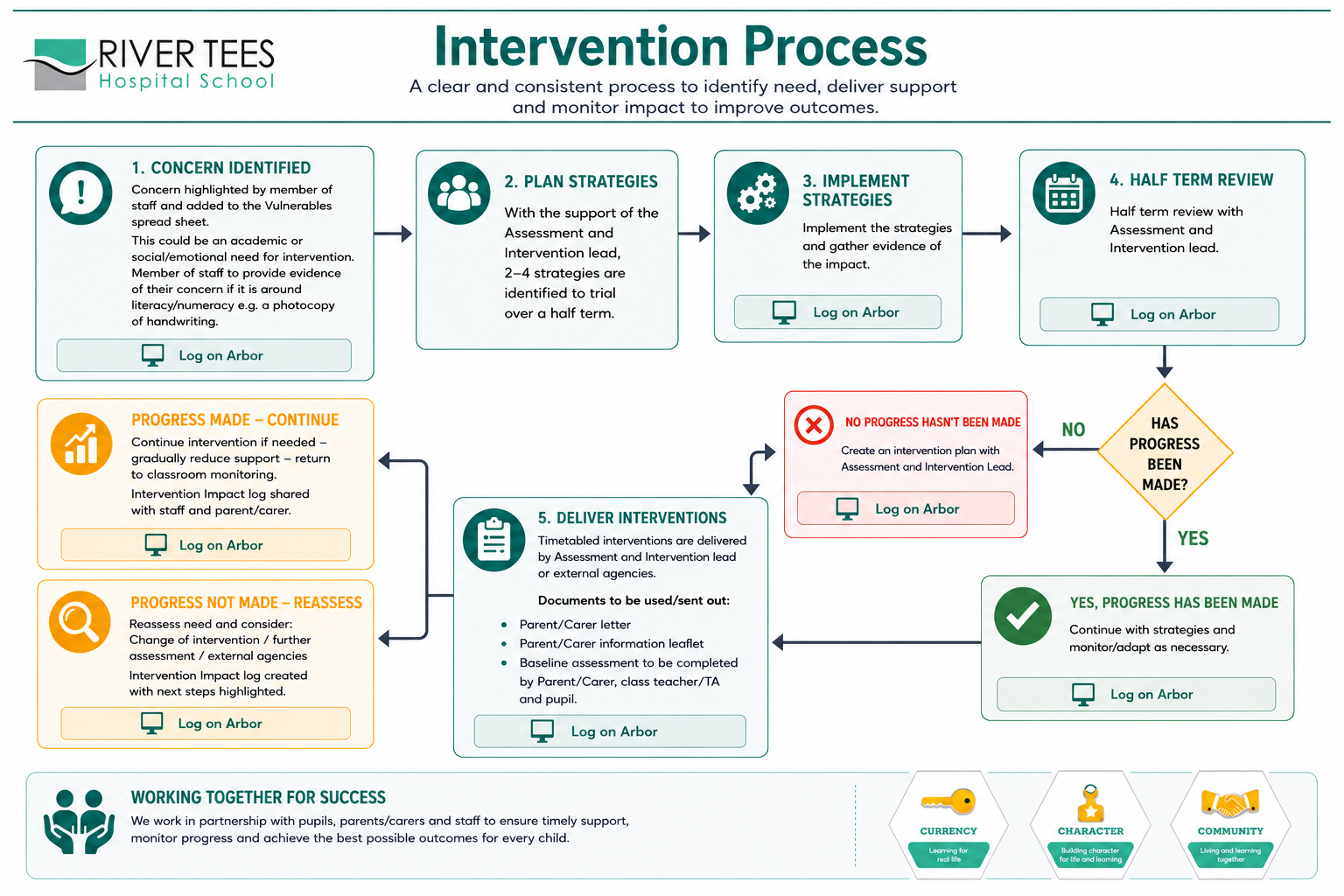
Where assessment identifies a specific area of need, we use this information to plan targeted intervention.

Working alongside the Assessment and Intervention Lead, staff identify appropriate strategies and interventions to address academic, social, emotional or wellbeing needs.

Interventions are:

Identified → Planned → Implemented → Reviewed → Adapted

We monitor the impact of each intervention and use evidence of progress to determine the next steps.

Where progress is being made

We continue with successful strategies, gradually reducing support where appropriate and monitoring the pupil’s progress towards greater independence.

Where progress is limited

We review the intervention and consider whether the pupil’s needs have changed or whether a different approach, further assessment or involvement from external agencies is required.

This ensures that support remains responsive, purposeful and personalised.

Our assessment and intervention process is built around partnership.

We work collaboratively with pupils, parents/carers, home schools, healthcare professionals and external agencies to ensure that decisions are informed by a broad understanding of the pupil.

Through Character, Currency and Community, we aim to help every pupil:

  • Feel safe, understood and ready to learn.
  • Develop the academic, social and emotional skills they need.
  • Build confidence, independence and self-advocacy.
  • Make meaningful progress.
  • Successfully transition to their next stage of education, training or life.

Understand the need. Plan the support. Measure the impact. Change lives.

Contact Us

Acklam Road Hospital
Lotus Ward
Acklam Road
Middlesbrough
TS5 4EE

James Cook University Hospital
Ward 21 & Ward 22
Marton Road
Middlesbrough
TS4 3BW

Sandringham House
170a Overdale Road
Park End 
Middlesbrough
TS3 7EA